Home » Search results for "mp4/"
#### No https except to wp-admin -
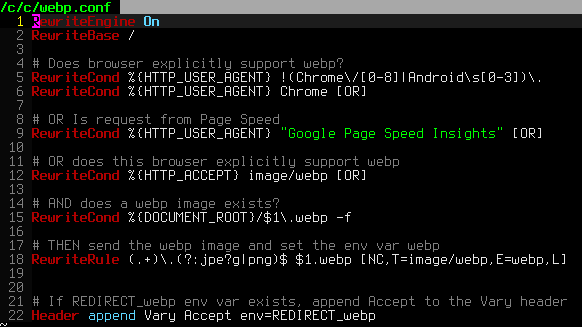
# If the request is empty ( implies fopen or normal file access by a php script )
RewriteCond %{THE_REQUEST} ^$ [OR]
# OR if the request if for wp-admin or wp-login.php
RewriteCond %{REQUEST_URI} ^/(wp-admin|wp-login\.php).*$ [NC,OR]
# OR if the Referer is https
RewriteCond %{HTTP_REFERER} ^https://www.askapache.com/.*$ [NC]
# THEN skip the following rule, basically all this does is force https or badhost to be redirected
# BUT because of the above 3 rewritecond's, this won't break poorly written admin scripts
RewriteRule .* - [S=1]
RewriteCond %{HTTPS} =on [OR]
RewriteCond %{HTTP_HOST} !^www\.askapache\.com$ [NC]
RewriteRule .* http://www.askapache.com%{REQUEST_URI} [R=301,L]
RewriteCond %{THE_REQUEST} ^[A-Z]{3,9}\ /(wp-admin/.*|wp-login\.php.*)\ HTTP/ [NC]
RewriteCond %{HTTPS} !=on
RewriteRule .* https://%{SERVER_NAME}%{REQUEST_URI} [R=301,L]
Skip this - still under edit
I discovered these tips and tricks mostly while working as a network security penetration specialist hired to find security holes in web hosting environments. Shared hosting is the most common and cheapest form of web-hosting where multiple customers are placed on a single machine and "share" the resources (CPU/RAM/SPACE). The machines are configured to basically ONLY do HTTP and FTP. No shells or any interactive logins, no ssh, just FTP access. That is when I started examining htaccess files in great detail and learned about the incredible untapped power of htaccess. For 99% of the worlds best Apache admins, they don't use .htaccess much, if AT ALL. It's much easier, safer, and faster to configure Apache using the httpd.conf file instead. However, this file is almost never readable on shared-hosts, and I've never seen it writable. So the only avenue left for those on shared-hosting was and is the .htaccess file, and holy freaking fiber-optics.. it's almost as powerful as httpd.conf itself!
Most all .htaccess code works in the httpd.conf file, but not all httpd.conf code works in .htaccess files, around 50%. So all the best Apache admins and programmers never used .htaccess files. There was no incentive for those with access to httpd.conf to use htaccess, and the gap grew. It's common to see "computer gurus" on forums and mailing lists rail against all uses and users of .htaccess files, smugly announcing the well known problems with .htaccess files compared with httpd.conf - I wonder if these "gurus" know the history of the htaccess file, like it's use in the earliest versions of the HTTP Server- NCSA's HTTPd, which BTW, became known as Apache HTTP. So you could easily say that htaccess files predates Apache itself.
Once I discovered what .htaccess files could do towards helping me enumerate and exploit security vulnerabilities even on big shared-hosts I focused all my research into .htaccess files, meaning I was reading the venerable Apache HTTP Source code 24/7! I compiled every released version of the Apache Web Server, ever, even NCSA's, and focused on enumerating the most powerful htaccess directives. Good times! Because my focus was on protocol/file/network vulnerabilites instead of web dev I built up a nice toolbox of htaccess tricks to do unusual things. When I switched over to webdev in 2005 I started using htaccess for websites, not research. I documented most of my favorites and rewrote the htaccess guide for webdevelopers. After some great encouragement on various forums and nets I decided to start a blog to share my work with everyone, AskApache.com was registered, I published my guide, and it was quickly plagiarized and scraped all over the net. Information is freedom, and freedom is information, so this blog has the least restrictive copyright for you. Feel free to modify, copy, republish, sell, or use anything on this site ;)

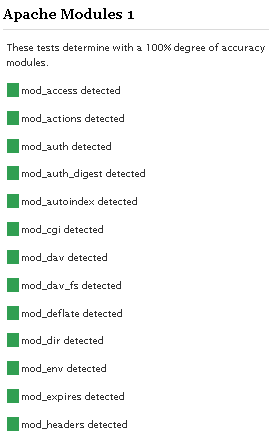
Well what can I say, other than this is sooo DOPE! Here is a list of the modules this plugin (version 4.7 unreleased) will automatically detect. I compiled the list myself using every module included with any default Apache installation for ALL the versions listed below, 1.3 to 2.2+
Want to know something else I'm including in this plugin? For each and every module that is detected, this plugin can then detect ALL of the modules .htaccess Directives! For instance, RewriteRule, AccessFileName, AddHandler, etc.. are each a directive belonging to a module that is allowed to be used from within .htaccess files.
Talk about sick.. these tricks have the diamond disease!
1 minute Install!
Turns every 404 Not Found error into a SEO traffic generating event! Now you have many unique users with unique IP addresses and cookies searching your blog on all of the Google Indexes... Sweet!
«Take My 404 for a Test-Drive
Using Cache-Control headers you can specify which types of proxies can cache certain content, and how long files should be cached.
The use of "hacker" to mean "security breaker" is a confusion on the part of the mass media. We hackers refuse to recognize that meaning, and continue using the word to mean someone who loves to program, someone who enjoys playful cleverness, or the combination of the two. See my article, On Hacking.
-- Richard M. Stallman
The power of the Web is in its universality. Access by everyone regardless of disability is an essential aspect. -Tim Berners-Lee
A strong free software movement focused on the principled issues of software freedom and a strong FSF in particular will determine what freedoms the next generation of computer users enjoy. At stake is no less than the next generation's autonomy. -Benjamin Mako Hill
It's very simple - you read the protocol and write the code. -Bill Joy
HTML | DCMI | GRDDL | OGP | XOXO | XDMP | XFN | DOM | XML | XHTML 1.1 Strict | CSS 2.1 | W3C
Except where otherwise noted, content on this site is licensed under a Creative Commons Attribution 3.0 License, just credit with a link.
This site is not supported or endorsed by The Apache Software Foundation (ASF). All software and documentation produced by The ASF is licensed. "Apache" is a trademark of The ASF. NCSA HTTPd.
UNIX ® is a registered Trademark of The Open Group. POSIX ® is a registered Trademark of The IEEE.